What Happens Before Sunrise at Bangkok's Flower Market?
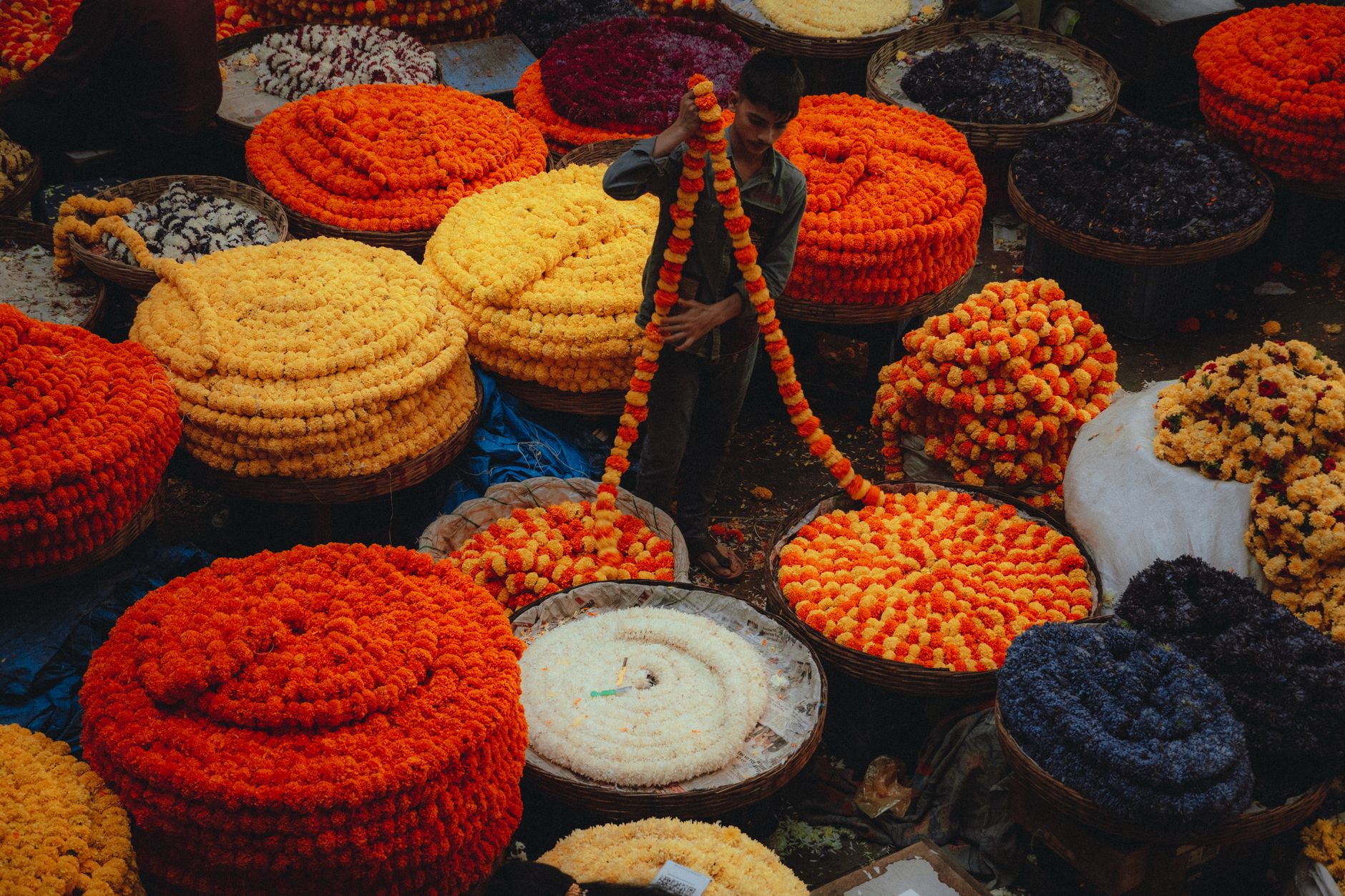
At three in the morning, most of Bangkok is as quiet as it ever gets. Pak Khlong Talat is not. The city's great flower market, strung along Chak Phet Road near the Memorial Bridge on the Chao Phraya River, is at that hour close to its daily peak: trucks backing into the sois, porters wheeling towers of banana-leaf-wrapped bundles, vendors stringing jasmine by the thousand under fluorescent light. The market technically never closes, but the version worth crossing the city for happens while the rest of the city sleeps.
Here is what actually goes on in those hours, and how to see it well.
Where the market is and why it sits there
Pak Khlong Talat means "market at the mouth of the canal," and the name explains the location. The market grew up where Khlong Rop Krung meets the Chao Phraya, in the old town just south of Wat Pho and the Grand Palace, because for more than a century produce and flowers came into Bangkok by boat. The boats are mostly gone — flowers now arrive by truck from growing provinces like Nakhon Pathom and from the cool hills of the north — but the market never moved.
That geography is good news for travelers. The nearest MRT station, Sanam Chai, is a few minutes' walk away, and the market sits within easy reach of the sights most Bangkok itineraries already include. A pre-dawn market visit stacks neatly against a morning at Wat Pho or the Grand Palace, which is exactly how the Bangkok days are built on a journey like the Thailand Culinary Journey, where markets are treated as destinations rather than photo stops.
The overnight rhythm, hour by hour
The market runs on a schedule set by wholesale buyers, not tourists, and it rewards anyone willing to match it.
- Around 10 p.m. to midnight, the trucks begin arriving in earnest. Orchids, roses, chrysanthemums and marigolds come in wrapped bales; lotus buds arrive in dripping baskets. Porters move everything by trolley at a pace that assumes you will get out of the way.
- Midnight to about 4 a.m. is the heart of it. This is when florists, hotel buyers, temple suppliers and street-stall garland sellers do their purchasing, in bulk and at speed. Prices are wholesale, negotiation is quick, and the aisles smell overwhelmingly of jasmine and damp greenery.
- 4 a.m. to sunrise, the pace eases into assembly work. Whole families sit at folding tables threading phuang malai — the jasmine-and-marigold garlands you will later see hanging from taxi mirrors and spirit houses — and folding the petals of lotus buds back one by one into neat rosettes for temple offerings.
- After sunrise, the market keeps trading all day, and it remains photogenic, but the wholesale theatre is over. Daytime visitors see a flower market; overnight visitors see a supply chain.
If a 2 a.m. outing sounds extreme, the honest compromise is roughly 5 to 7 a.m.: deliveries are winding down, the garland-makers are still working, the light begins to turn, and you can walk straight into breakfast afterward.
What the flowers are for
Understanding what is being sold makes the market far more interesting than a wall of pretty color. The marigolds, sold in fat orange ropes, are overwhelmingly destined for religious use — draped on Buddha images, shrines and spirit houses, where the color is associated with merit and auspiciousness. Lotus buds, folded or unfolded, are the standard temple offering; watch the vendors flick and fold the outer petals inward with a speed that comes from doing it ten thousand times. Jasmine goes into garlands whose scent is considered an offering in itself. Then there is the secular trade: roses and orchids by the hundred for hotels, restaurants, weddings and funerals, at prices that startle anyone used to florist mark-ups at home — a bundle of twenty roses can cost less than a Bangkok coffee.
Around the flower stalls, a second market carries on: chillies by the sackful, limes, galangal, holy basil and other kitchen staples, because Pak Khlong Talat has never stopped being a produce market too. For food-minded travelers this fringe is half the appeal, and it is the reason guides on culinary-focused itineraries like to start market mornings here before any cooking class begins.
How to visit without being in the way
The market is a workplace first and an attraction second, and the difference matters most in the overnight hours. A few practical rules keep the visit smooth. Stay alert for trolleys — porters call out or simply keep coming, and the loaded carts are heavier than they look. Keep walkways clear when you stop for photos, and ask before photographing vendors up close; most will nod, and many will hold up a garland for you. Small purchases are welcome even though the trade is wholesale — a single garland costs very little and makes you a customer rather than an obstacle. Wear closed shoes, because the floors are wet with melted ice and trimmed stems. And bring small cash; this is not a card economy.
Getting there before dawn means a taxi or ride-hail, since the MRT opens too late for the deepest overnight hours. The ride from most central hotels is short at that time of night, and the same car can usually wait or be re-hailed for the return.
Folding it into a Bangkok morning
The strongest argument for the pre-dawn visit is what it does to the rest of the day. From the market, it is a short walk north to Wat Pho as it opens at 8 a.m., ahead of the main crowds, and the Grand Palace follows next door. Riverside breakfast options sit between the market and the temples. By the time most visitors are starting their sightseeing, you have already watched the city provision itself with flowers, beaten the heat, and seen two major temples in soft light.
Travelers on a short Bangkok stay can manage all of this in one morning — the city portion of the five-day Thailand Heritage Escape leaves room for exactly this kind of early start, and longer journeys through the capital build mornings like it into the plan. For help choosing between them, the blog and the guide to choosing a Thailand tour operator are the places to start.
The flower market asks only one thing of visitors: show up at the hour when it is actually working. Do that, and a stop many itineraries reduce to a fifteen-minute photo op becomes one of the most memorable things you will see in Bangkok — a whole night-shift economy devoted to making the city smell of jasmine by morning.