Seven Ways to See Thailand Without the Crowds
Thailand's most photographed places are crowded for a reason, and no amount of planning will empty the Grand Palace at eleven in the morning. But crowding in Thailand is remarkably predictable. It clusters in a few hours of the day, a few months of the year, and a short list of sites that appear on every day-trip bus route out of Bangkok, Chiang Mai and Phuket. Step outside those patterns — often by ninety minutes, sometimes by forty kilometres — and the same country goes quiet.
Here are seven ways to build a Thailand trip around that idea, using the places that appear on real itineraries rather than obscure alternatives that cost a day of driving to reach.
1. Arrive before the day-trip buses do
Most crowding at Thailand's headline sites is imported. Coaches leave Bangkok hotels around 8:00 and reach Ayutthaya or Damnoen Saduak mid-morning; coaches leave Chiang Mai around 8:30 and reach Chiang Rai's White Temple near midday. The sites themselves open earlier than the buses arrive.
That gap is the whole trick. Wat Pho and Wat Arun open at 8:00 and are calm for the first hour. The Grand Palace opens at 8:30, and the difference between arriving then and arriving at 10:30 is the difference between photographing the Emerald Buddha's courtyard and queuing across it. At Damnoen Saduak, the floating market is a working canal at 7:00 and a tour-boat traffic jam by 9:30.
The same logic runs in reverse at the end of the day. Late afternoon at Ayutthaya, after the coaches have turned back toward Bangkok, is the best light and the smallest crowd of the day — Wat Chaiwatthanaram in particular rewards staying until dusk, when its prang is floodlit against the river.
2. Swap the famous version for the equally good one next to it
Nearly every crowded attraction in Thailand has a quieter equivalent within a short drive, and in most cases it is not a consolation prize.
Damnoen Saduak is the floating market everyone knows; the Maeklong Railway Market, an hour away, is stranger and more memorable — vendors folding their awnings back as a train rolls through the produce stalls, several times a day. In Bangkok, the Grand Palace draws the queues while Wat Pho next door holds the reclining Buddha and a working massage school in near calm. In Chiang Rai, Wat Rong Khun — the White Temple — is the famous one, and the Blue Temple a few minutes away is very nearly empty most afternoons.
The pattern holds at scale too: Ayutthaya gets the day trips because it is ninety minutes from Bangkok, while Sukhothai, the older capital, sits far enough north that the coach traffic never reaches it.
3. Give Sukhothai the time other itineraries give Ayutthaya
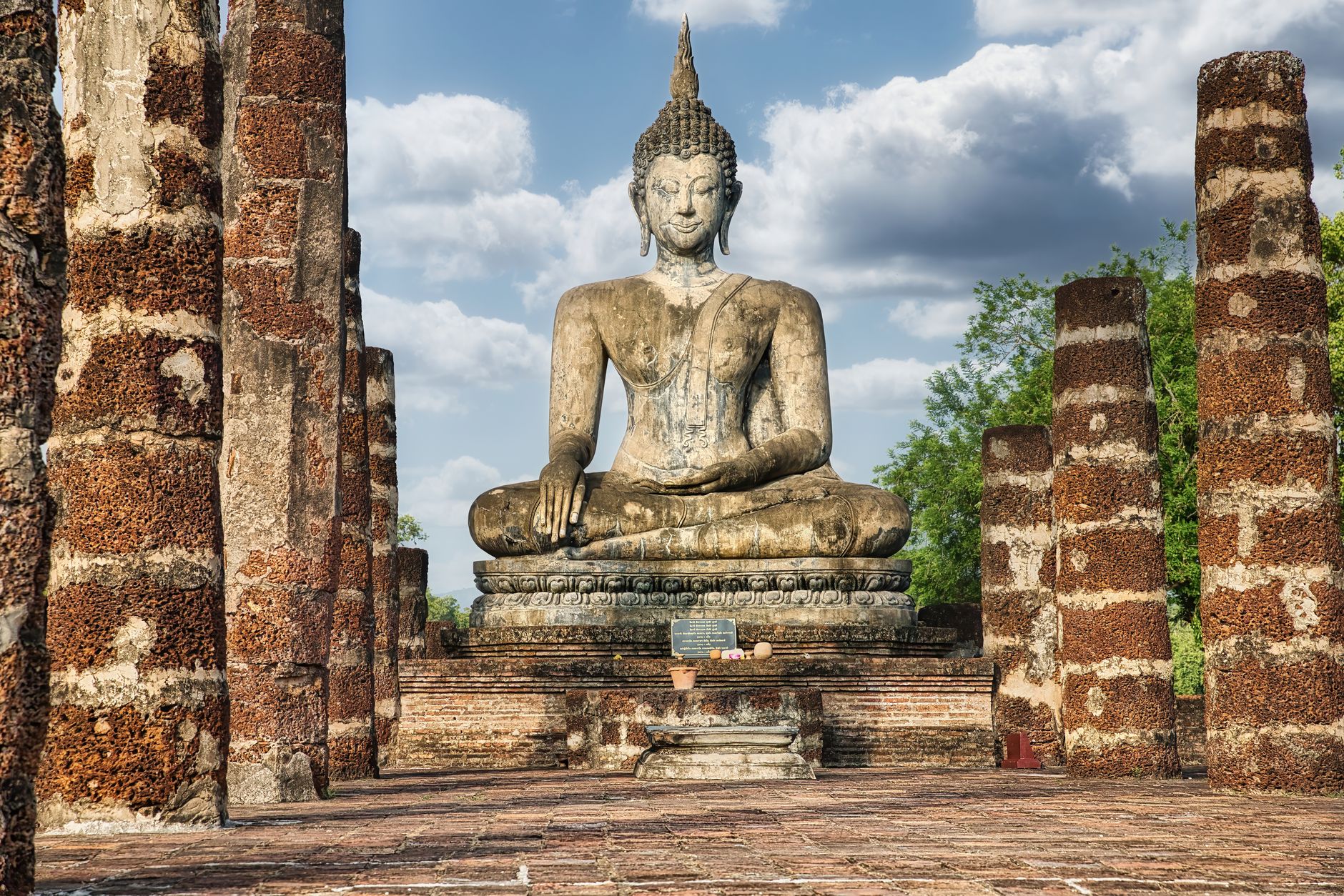
Sukhothai Historical Park is the strongest argument in the country for the quieter option. It is a UNESCO World Heritage site, the ruins are older and better preserved than Ayutthaya's, and the central zone is laid out as a park you can cycle through — lotus ponds, seated Buddhas, and long sightlines that Ayutthaya's roadside setting cannot offer.
It also sees a fraction of the visitors, mainly because it is roughly five to six hours north of Bangkok by road and most short itineraries skip it. Trips that cross the country overland pick it up on the way to Chiang Mai, which is how it ends up on both the Thailand Discovery and the Grand Thailand Journey routings. If crowds are your main objection to Thailand, this is the single site most worth building an itinerary around.
4. Use Kanchanaburi as the counterweight to Bangkok
Kanchanaburi is two and a half hours west of Bangkok and gets a fair number of visitors, but it absorbs them differently: the sites are spread along a river valley rather than stacked inside a walled compound.
The bridge on the River Kwai is busiest in the middle of the day. Hellfire Pass, further out, is quiet almost any time — a cutting through rock dug by prisoners of war and Asian labourers, with a memorial museum that is among the most carefully done in the country. The JEATH War Museum and the Allied cemeteries in town are sober, small and rarely busy. It is a place where the crowd question mostly answers itself, and it anchors the short Thailand Heritage Escape out of Bangkok.
5. Choose the month before or after everyone else's
Thailand's crowding calendar is more forgiving than its weather calendar, and the two do not overlap perfectly.
- November to February is peak season: dry, cool, and the busiest months at every site on this list.
- Late February and March hold most of the dry-season weather while the high-season crowds thin out.
- June to early October is the green season — rain usually arrives in heavy afternoon bursts rather than all-day drizzle, prices soften, and the historical parks are close to empty.
- Mid-April is Songkran, and November's full moon is Loy Krathong: both are worth planning toward or around deliberately, never by accident.
Shoulder months are also when small-group departures feel smallest, since the groups themselves are lighter.
6. On the coast, travel on the boats' schedule
Island crowding is a timing problem more than a place problem. Phi Phi's Maya Bay and Phang Nga's James Bond Island are at their worst between roughly 10:00 and 14:00, when the day boats from Phuket converge; both are calm on either side of that window.
Krabi's Four Islands trip follows the same rhythm — an early departure from Ao Nang changes the day completely. And on Phuket itself, the crowds concentrate on a few west-coast beaches: Kamala, Old Phuket Town's Sino-Portuguese streets, and the quieter stretches near Klong Muang on the Krabi side stay comparatively relaxed even in high season. That coastal pairing is the shape of the Thailand Tropical Escape.
7. Let the itinerary do the avoiding for you
Timing only works if someone is actually holding the schedule to it. A tour that leaves Bangkok at 8:30 because that is when breakfast finishes will arrive everywhere exactly when the crowds do.
This is where how a trip is run matters more than what is on the day-by-day list. Asia Bound's Thailand journeys are operated on the ground by BCX, an independent local operator based in Bangkok, which is why the itineraries run at local hours — early starts at temple sites, historical parks in the soft light, and travel days scheduled around known bus patterns rather than against them. Small-group sizes matter for the same reason: a group of a dozen enters a temple compound without becoming the crowd.
The Thailand Discovery route (Bangkok, Ayutthaya, Sukhothai, Chiang Mai, Chiang Rai) is the most crowd-averse of the five, since three of its five stops are places the day-trip traffic never reaches. It starts at $2,199 per person, land only, currently $2,049 through 15 October. International airfare is not included — guests book their own flights, and Asia Bound helps find the best value for the chosen dates.
If you are weighing operators as much as itineraries, the guide to choosing a Thailand tour operator covers what to ask about group size, pacing and who actually runs the trip on the ground. Questions about a specific departure month are best sent through the contact form — crowd levels vary enough between, say, early December and late February that the honest answer depends on the dates.