Sukhothai from First Light to Last: How to Spend a Day in the Historical Park
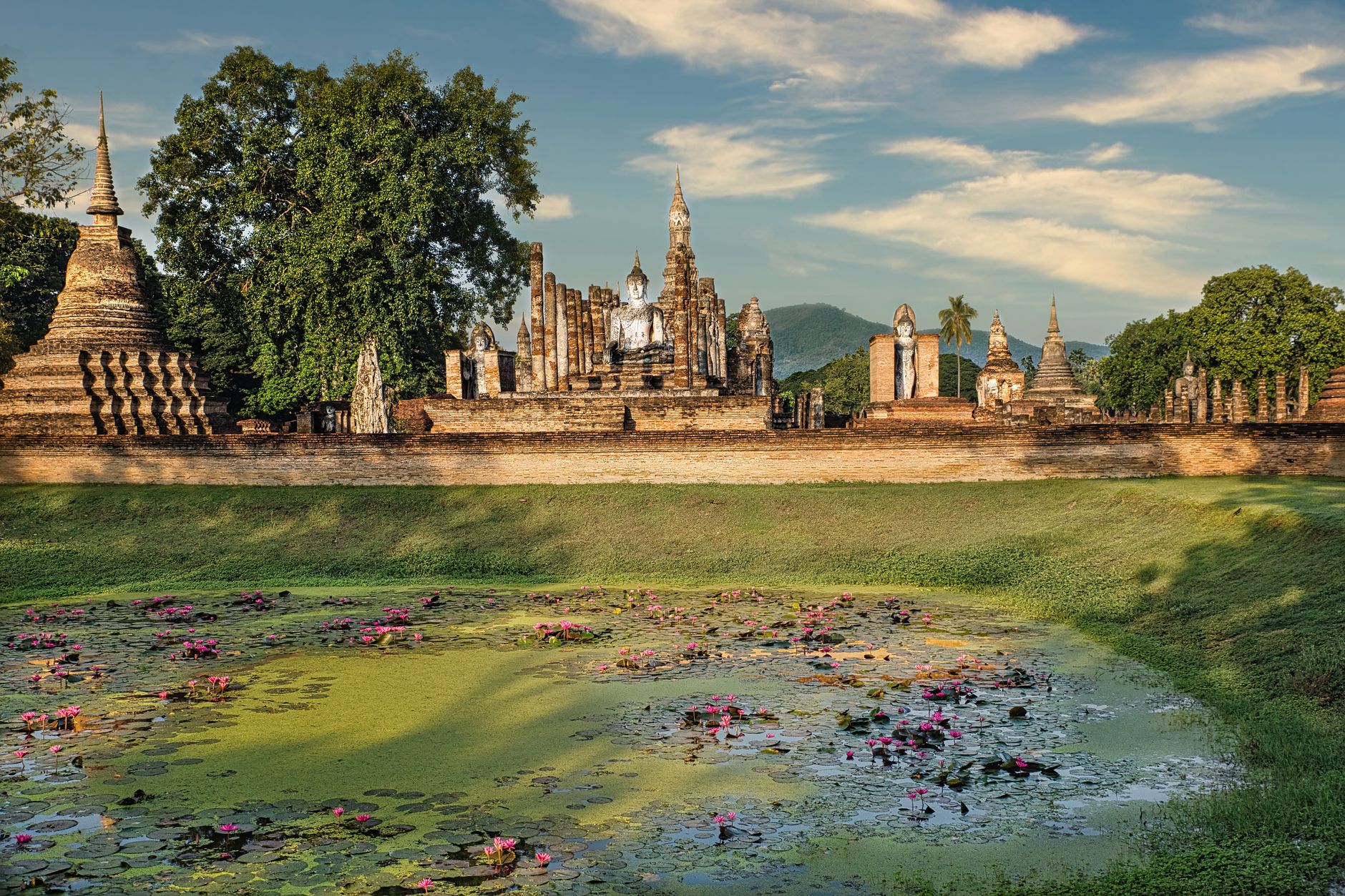
The central zone opens before seven, and for the first hour the park belongs to the groundskeepers, a few monks crossing between the ponds, and whoever managed to get up. Mist sits on the water around Wat Sa Si. The brick is still cool enough to touch. By ten the same ground will be throwing back heat hard enough to send most visitors in search of a fan and a cold drink, which is the single most useful thing to know about Sukhothai: a day here works best as two half-days with a long gap in the middle.
Sukhothai Historical Park lies roughly 12 kilometres west of the modern town, on the site conventionally described as the first capital of a unified Thai kingdom. It was inscribed as a UNESCO World Heritage Site in 1991, together with the related historic towns of Si Satchanalai and Kamphaeng Phet. What survives is not one monument but a dispersed city — walls, moats, reservoirs, and the brick and laterite bones of dozens of temples spread across several square kilometres of parkland. That scale is the reason Sukhothai feels different from Ayutthaya, where the ruins are threaded through a working provincial city. Here, the city is gone and the fields and frangipani have moved in.
First light in the central zone
Inside the old walls, the central zone holds the densest cluster, and Wat Mahathat is its anchor. The temple's signature is the lotus-bud finial on the main chedi — a tapering bud shape that is distinctly Sukhothai rather than Khmer or Sinhalese — surrounded by rows of smaller stupas and the stumps of columns that once carried a roof over a seated Buddha. Early on, the light comes in low across the water and the whole platform is legible: you can read where the assembly hall stood, where the enclosure wall ran, where the processional axis pointed.
A short walk north, Wat Sa Si sits on an island in a reservoir, reached by a low causeway. It is smaller and quieter, and it holds one of the walking Buddha figures that Sukhothai sculptors effectively invented — weight on one foot, robe falling in a single smooth line, the whole thing designed to look as if it is moving past you. West of Wat Mahathat, the three Khmer-style prangs of Wat Si Sawai are a reminder that the site was in use before the Sukhothai kings, built as a Hindu shrine and later absorbed into a Buddhist complex.
Bicycles are the right way to cover this. Rental stands cluster near the central-zone entrance and charge roughly 30 to 50 baht for the day, and the paths inside are flat, shaded in stretches, and almost entirely free of traffic. Walking the central zone alone is perfectly possible; walking between zones is not, in that heat.
North: the Buddha in the narrow box
The north zone, a few minutes' ride beyond the old wall, is worth the separate ticket for one thing in particular. Wat Si Chum encloses an enormous seated Buddha — Phra Achana — inside a square mondop whose walls rise almost to the figure's shoulders, leaving only a tall vertical slit at the front. The effect from the approach path is a single eye and a sliver of face; step through the gap and the statue fills the entire sky above you. The fingertips of the right hand are layered with gold leaf pressed on by visitors over the years. There is an old story about a hidden stair inside the wall and a voice that spoke to assembled troops, which may or may not be true but is told at the site anyway.
Nearby, Wat Phra Phai Luang spreads out as a looser, less restored group of prangs and standing walls, and it tends to be nearly empty. It is the best place in the park to get a sense of what the whole site looked like before the excavation and clearing work of the twentieth century.
The middle of the day belongs to the museum
Between about eleven and three, Sukhothai is unkind. The sensible move is the Ramkhamhaeng National Museum near the central zone entrance, which is air-conditioned and genuinely clarifying: bronzes, ceramics from the Si Satchanalai kilns, architectural fragments, and reproductions of the stone inscriptions that are the main written source for the period. Thirty or forty minutes there makes the afternoon's ruins read more clearly, because you have seen what used to stand in the empty niches.
The alternative is a long lunch in Old Sukhothai village, where the local dish worth ordering is Sukhothai noodles — pork, green beans, peanuts, a slightly sweet broth, nothing like the noodle soups further north.
Late afternoon: the hill at Saphan Hin
The west zone is more of a landscape than a temple group. Wat Saphan Hin stands on a low hill reached by a path of laid slate slabs — the "stone bridge" the name refers to — climbing a few hundred metres at a grade that is modest but hot. At the top, a standing Buddha some twelve metres high faces back east over the plain toward the walled city. Late afternoon is the time to do it: the climb is bearable, and the view takes in the tree line and the scattered chedis between here and the centre.
Back inside the walls for the last hour, Wat Mahathat changes completely. The crowds thin after four, the brick turns orange, and the lotus-bud chedi gets the kind of side light that explains why photographers come here in the first place.
Practical notes
- Tickets: zones are ticketed separately, around 100 baht each for foreign visitors, with a small additional charge to bring a bicycle in. A combined ticket covering the zones and the museum is usually sold at the central entrance and is the better value if you plan to see more than the centre.
- Hours: the central zone opens around 6:30am and closes around 6:30pm; the outer zones keep shorter hours, roughly 8:00am to 4:30pm, so do them before the late-afternoon return to the centre.
- Dress: shoulders and knees covered. Several of the mondops and viharns are active places of worship, not just ruins.
- Season: November through February is the comfortable window. In November, the full-moon Loy Krathong celebrations at the park draw large crowds and a light-and-sound programme among the ruins.
- Footwear: laterite and brick underfoot, plus the slate climb at Saphan Hin. Sandals are a mistake.
Where Sukhothai fits in a route
Sukhothai is usually a one-night stop, which is the right length — it is a half-day site done twice, not a two-day city — and it works best as the hinge between the old river capitals to the south and the north. Travelling Bangkok to Ayutthaya to Sukhothai to Chiang Mai gives the ruins a chronology: the Khmer-influenced prangs, then Sukhothai's own lotus-bud and walking-Buddha vocabulary, then the Lanna temples of the north.
That is the shape of Thailand Discovery, 12 days and 10 nights from Bangkok through Ayutthaya and Sukhothai to Chiang Mai and Chiang Rai, from $2,199 per person land only — $2,049 on the current sale through 15 October. The longer Grand Thailand Journey adds Kanchanaburi and the River Kwai before the ruins and finishes on the coast in Phuket, 15 days and 13 nights from $2,999 per person land only, $2,549 on sale through the same date. Both are small-group itineraries run on the ground by an independent local operator based in Bangkok, and on both the historical park is reached with a guide who can point at an empty niche and say what used to be in it.
Either way, the advice that matters is the same one the heat enforces: start at opening, disappear in the middle of the day, and be back at Wat Mahathat before the light goes. More on planning a Thailand route is in the blog and the guide to choosing a Thailand tour operator, and specific questions are best sent through the contact form.