The Secret Language of Thai Temple Architecture
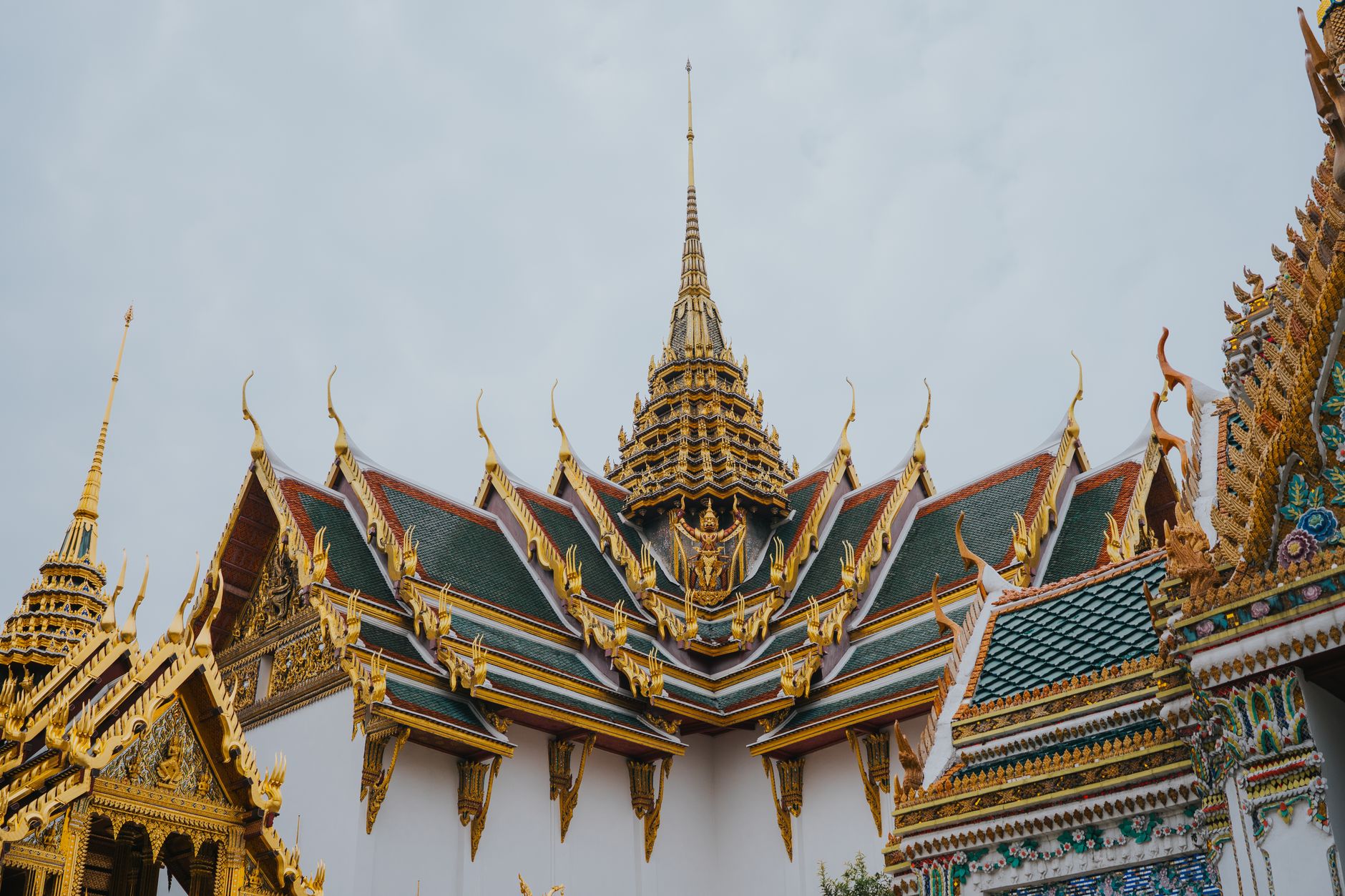
Walk into a Thai temple compound and the first impression is usually abundance: gold, glass, serpents, tiered roofs stacked like folded paper. It reads as decoration. It isn't. Almost every element on a Thai wat is doing a job — marking a building's status, naming a dynasty, telling you which hall you are allowed to enter, or recording which century the place was built in.
Once you can read a few of these signals, the hundredth temple stops looking like the first. Here are seven details worth learning before a trip through Bangkok, Ayutthaya, Sukhothai and the north — the stretch of country covered by the Thailand Discovery itinerary.
1. The horns on the roofline are a bird, and they tell you the building matters
The slender, upward-curving finial at each end of a temple roof ridge is called a chofa — roughly, "sky tassel." It is usually read as the head and beak of Garuda, the mythical bird that carries the god Vishnu, or in some interpretations a naga, the serpent guardian. Scholars still argue about which; builders have carved both.
What is not ambiguous is the signal. Chofa appear on sacred and royal buildings, not on ordinary ones. Running down the sloping bargeboard beneath each chofa you'll find a row of serrated fins — bai raka, the bird's feathers or the serpent's crest — ending in a flared tail at the eave called a hang hong, the "swan's tail," which on many temples resolves into a cluster of naga heads. A roof with all three is announcing a consecrated building.
2. Count the roof tiers
Thai temple roofs are built in overlapping layers, each tier shorter than the one below it, which is why the silhouette seems to cascade. The number of tiers is not an aesthetic whim. More tiers mean higher status, and royal foundations tend to carry three or four where a village hall carries one or two.
The glazed tiles matter too. Green, orange and amber are the standard palette of central Thailand, and the colour blocks are often laid in bands so the roof reads as striped from below. At Bangkok's Grand Palace complex the tiling is deliberately showy; in the Lanna temples around Chiang Mai, roofs sit lower and heavier, sweep closer to the ground, and lean on dark wood rather than glaze.
3. The eight stones that separate a wihan from an ubosot
This is the single most useful thing to know, because it changes what you look at. A temple compound usually has two main halls that look similar from outside:
- The ubosot (ordination hall) is the consecrated building, where monks are ordained. It is marked by eight sema — boundary stones, often leaf-shaped and sometimes sheltered in small pavilions — set at the four cardinal points and four corners. Those stones are the consecration.
- The wihan (assembly hall) holds the principal Buddha image and is the hall laypeople and visitors generally use.
So when you see small carved stones standing sentry around one building and not the other, you have found the ritual heart of the compound. Some ubosot restrict entry; many don't. At Ayutthaya's ruined temples the halls themselves are gone, but the sema stones frequently survive, which is how archaeologists know what stood where.
4. Chedi or prang — the shape names the dynasty
Thailand's two main tower forms come from two different directions, and telling them apart dates a site faster than any plaque.
A chedi is the bell or cone shape, descended from the Indian and Sri Lankan stupa, built to enshrine relics. A prang is the tall, tapering corn-cob tower, Khmer in origin, which came into Thai building through Angkorian influence and was embraced by the Ayutthaya kings as a mark of imperial prestige.
Walk Ayutthaya and you'll see both arguing with each other: the three restored chedi at Wat Phra Si Sanphet against the ring of prang at Wat Chaiwatthanaram. Sukhothai, older and more independent, invented its own signature — the lotus-bud chedi, a square tower topped with a tight bud finial, which appears nowhere else as a native form. In Bangkok, Wat Arun's central prang, rising roughly seventy metres above the river, is the Rattanakosin era reaching deliberately back to Khmer vocabulary.
5. The staircase is a serpent, and you are walking up its spine
The balustrades flanking temple stairs are almost always naga — multi-headed water serpents, guardians of thresholds and of the Buddhist teaching itself. The naga's body forms the handrail; its heads fan out at the bottom step. Crossing it is the point: you are passing from the ordinary world into a sacred precinct.
The most committed example on the usual northern route is the climb to Wat Phra That Doi Suthep above Chiang Mai, where a naga balustrade runs the length of roughly three hundred steps up to the terrace. (There is a funicular for anyone who would rather not.) Look for the same creature in miniature everywhere else — on the corners of chedi bases, at the end of eaves, curled around door frames.
6. Mirror glass, porcelain and the Rattanakosin shine
The glitter on Bangkok temples is not paint and usually not gold leaf. It is thousands of small pieces of coloured mirror glass set into stucco, a Rattanakosin-era technique that makes a column flare in direct sun and go matte in shade. Wat Arun does something related and stranger: its prang are encrusted with broken Chinese porcelain — plates, bowls and cups, some arriving as ballast in trading ships — assembled into flowers and mythical figures. Get close enough and you can pick out individual rim fragments.
Contrast that with Sukhothai, where almost nothing shines. The fourteenth-century aesthetic was brick, laterite and stucco, with the drama carried entirely by proportion and by the Buddha images themselves. Two eras, two completely different theories of how holiness should look.
7. The Buddha's hands are a sentence
Posture and hand gesture — mudra — identify the moment being depicted, and the repertoire is small enough to learn in an afternoon.
The seated figure with the right hand touching the ground is bhumisparsha, calling the earth to witness at the moment of enlightenment; it is the most common image in Thailand by a wide margin. A standing figure with both palms raised outward is calming or restraining. The great reclining figure at Wat Pho depicts the Buddha entering parinirvana, not resting.
Sukhothai's sculptors added the one genuinely Thai contribution to the canon: the walking Buddha, mid-stride with one heel lifted and robes flowing, a posture that barely exists elsewhere in Buddhist art. Several survive in and around Sukhothai Historical Park, and once you have seen one, the Sukhothai style — the long oval face, the flame finial on the crown, the impossibly fluid shoulders — is unmistakable anywhere.
None of this requires scholarship to use. It requires about twenty minutes of attention on the first temple and then a habit: look up at the roofline, look down for the stones, check whether the tower is a bell or a cob. Guided itineraries help here mainly by sequencing — seeing Sukhothai before Ayutthaya before Bangkok puts the styles in chronological order, so each site explains the next. That is how the five-day Thailand Heritage Escape is built around Bangkok, Kanchanaburi and Ayutthaya, and how the longer Grand Thailand Journey threads Sukhothai and the Lanna north onto the same line.
If you are weighing how much temple time a trip should carry, the guide to choosing a Thailand tour operator covers how to read an itinerary for pace. More on the individual sites is on the blog.