Why Thailand Has a Different Color for Every Day of the Week
Walk into a Bangkok bank on a Monday and a striking number of the tellers will be in yellow. Pass a government office on a Friday and the blue is just as consistent. Nurses, schoolteachers, hotel front desks: subtle until you notice it, then everywhere.
It is not coordination, and it is not a uniform policy. Thailand runs on a color calendar. Every day of the week has an assigned color, and nearly every Thai person knows which color belongs to the day they were born.
A planet, a deity, a color
The system arrived from Hindu astrology, absorbed into Thai court and temple life centuries ago by way of Brahmin ritual specialists who served the royal palace. Each weekday is governed by a planetary deity, and each deity has a body color in the old iconography. The day inherits it.
- Sunday — red. Surya, the sun.
- Monday — yellow, sometimes softened to cream. Chandra, the moon.
- Tuesday — pink. Mangala, the planet Mars.
- Wednesday — green by day, grey by night. Budha governs the daylight hours; the night belongs to Rahu, the eclipse deity, who takes grey or black.
- Thursday — orange. Brihaspati, Jupiter, the teachers' planet — which is why wai khru, the teacher-honoring ceremony, is traditionally held on a Thursday.
- Friday — blue. Shukra, Venus.
- Saturday — purple. Shani, Saturn.
Wednesday's split is the detail that catches visitors out: in the full version of the scheme there are eight slots, not seven. Fortune-telling versions go further, pairing each day with colors to avoid as well as colors to wear.
Why yellow is the loudest of the seven
Monday's yellow carries weight far beyond astrology. King Bhumibol Adulyadej, Rama IX, was born on a Monday, and across his seven-decade reign yellow shifted from a weekday color to a national one. The high-water mark came in 2006, the sixtieth anniversary of his accession, when yellow shirts sold out nationwide. Queen Sirikit was born on a Friday, so light blue surfaces every 12 August, her birthday and Thailand's Mother's Day. King Vajiralongkorn, Rama X, was also born on a Monday, so yellow has kept its place; expect a great deal of it around 28 July.
The reverse holds too. After Rama IX's death in October 2016, the country wore black and white for a year. The color code is a living social language, not a folk curiosity, and it moves with events.
Eight Buddhas, one for each day
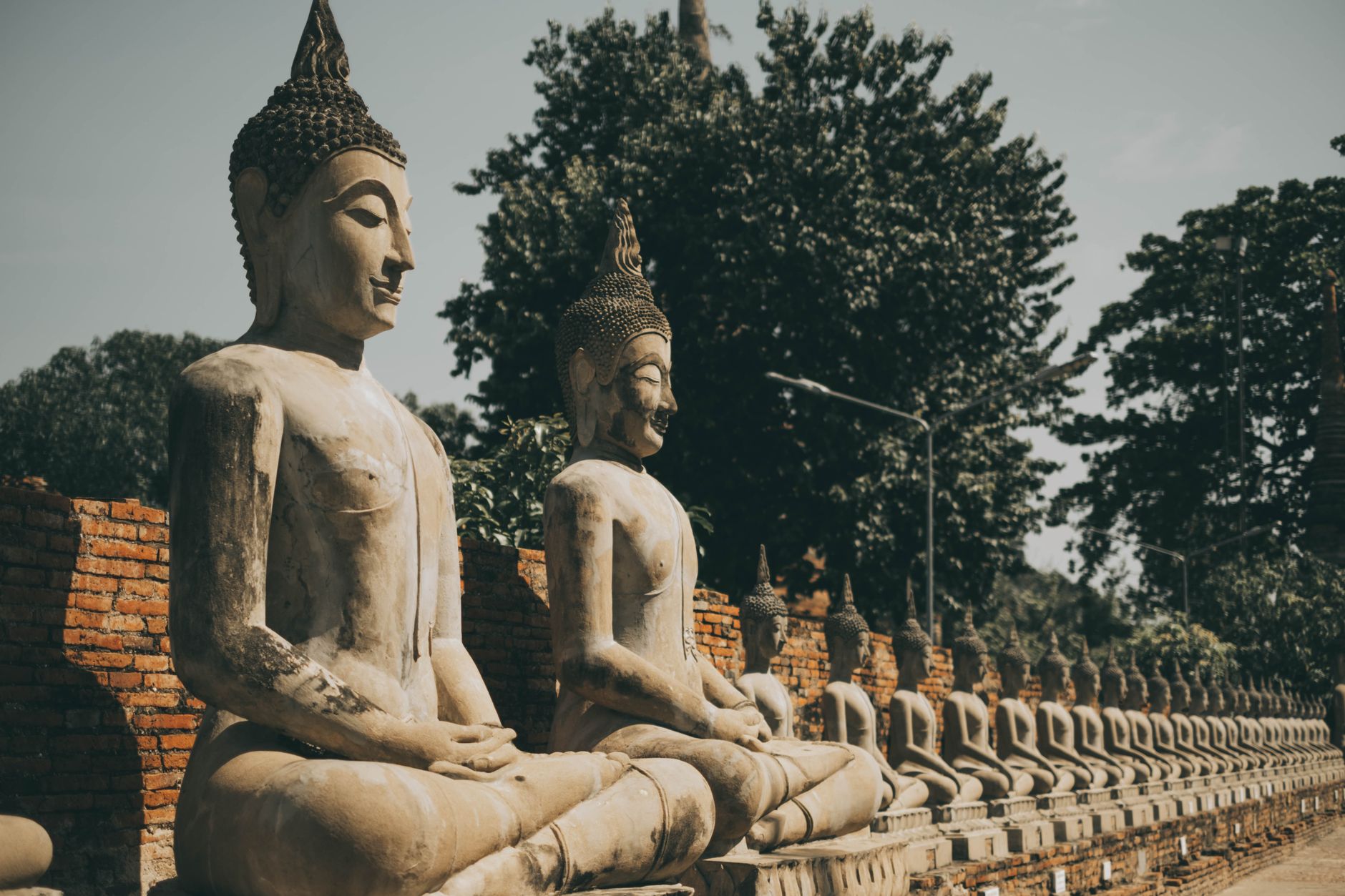
The place a traveler will actually see the system working is a temple courtyard. In the cloisters of most working wats there is a row of Buddha images — eight of them, not seven, because of Wednesday's division — each in a different posture, each with a donation bowl in front. Thais find the image matching their birth weekday, bow, and drop coins in that bowl.
The postures are worth learning, because once you know them you stop seeing a row of near-identical statues. Sunday's Buddha stands with hands crossed loosely at the waist, representing the seven days spent gazing at the Bodhi tree after enlightenment. Monday's stands with the right palm raised outward, the gesture for halting a quarrel. Tuesday's is the reclining Buddha — which means the enormous gilded figure at Wat Pho in Bangkok, one of the most photographed objects in the country, is a Tuesday image. Wednesday's daytime Buddha carries an alms bowl; the Wednesday-night image sits in a forest attended by an elephant and a monkey. Thursday's is seated in plain meditation, Friday's stands with both arms folded across the chest, and Saturday's sits beneath the spread hood of a naga, the serpent that sheltered the Buddha from a storm.
At Ayutthaya the connection is harder to read, since what survives there is mostly seated images and ruined brick. Bangkok's wats are the clearest place to see the whole scheme laid out at once, and a guide who knows the postures turns a courtyard you would otherwise walk past into ten interesting minutes. A short itinerary like the Thailand Heritage Escape — five days and four nights through Bangkok, Kanchanaburi and Ayutthaya, from $499 per person, land only — spends enough time in Bangkok's wats for the pattern to click before you reach the old capital.
What this means for your packing
Very little is expected of foreign visitors here. Nobody will check your shirt against a calendar, and no Thai person will think less of a traveler in Tuesday grey. A few things are worth knowing anyway.
Temple dress codes matter far more than color: covered shoulders, covered knees, shoes off where indicated. A yellow top is genuinely useful if your trip crosses a royal occasion, and almost weightless to pack. And if the country is in an announced mourning period, muted clothing is the respectful default — this is the one situation where color carries real weight for visitors.
One last suggestion costs nothing. Look up the weekday you were born on before you fly. A thirty-second search turns a temple courtyard from polite observation into something closer to participation: finding your own image, working out the posture, seeing which of the eight bowls the coins pile up in. Longer routes north, such as Thailand Discovery through Chiang Mai and Chiang Rai, show the same scheme in regional styles, which is when the variations get interesting.
More Thailand planning reading sits on the blog; questions about any of the five journeys go through contact.