The Story Behind Thailand's Famous Three-Headed Elephant
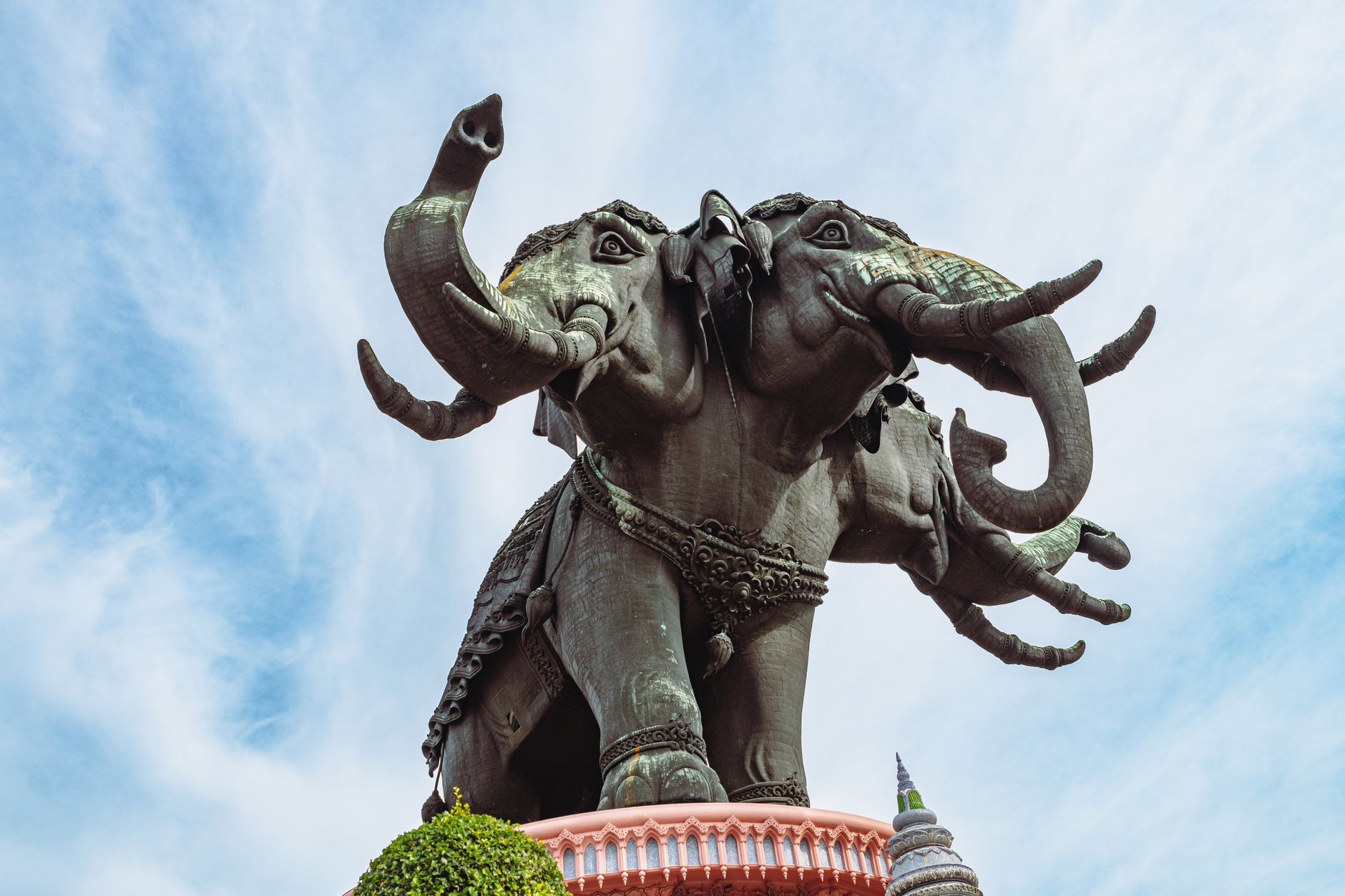
Ride the BTS Sukhumvit line south out of central Bangkok and, somewhere past the city's last tall condos, an apparition slides into the train window: a colossal elephant with three heads, standing on a domed pink pedestal, its copper-green skin catching the light above the expressway traffic. It is not a billboard and not a temple. It is a 250-ton statue with a museum inside its belly, and the station that serves it is named, helpfully, Chang Erawan — "Erawan elephant."
Travelers meet this creature long before they reach that station. It appears on the seal of Bangkok itself, on temple gables, on banknote engravings and government letterheads, in shrine carvings and hotel logos, and in the name of one of Thailand's loveliest waterfalls. One animal, three heads, everywhere. This is the story of how it got there.
A god's mount, born from a churning ocean
Erawan is the Thai name for Airavata, the king of elephants in Hindu mythology. In the old Sanskrit telling, when gods and demons churned the celestial ocean of milk to extract the elixir of immortality, a series of treasures rose from the foam — and among them came a radiant white elephant. Indra, the storm god and king of the heavens, claimed him as his mount. When Indra rides out to do battle or bring the rains, he rides Airavata.
The story traveled into Southeast Asia with Hinduism and Buddhism, and Thai tradition made it grander still. In the Traiphum, the old Thai Buddhist account of the structure of the universe, Erawan is described with thirty-three heads, each head bearing seven tusks — a creature no sculptor could reasonably render. Thai artists settled on a convention that captures the idea without the arithmetic: three heads, serene and symmetrical, often with trunks curled in unison. That three-headed silhouette became the standard, and it is the one you will see repeated across the country.
Two things carried over from the myth and still matter in Thailand. First, Erawan is a white elephant, and white elephants have signified royal merit and legitimate kingship in Siam for centuries — rare pale elephants were presented to the king, and their discovery was read as an omen of a righteous reign. Second, Erawan belongs to Indra, and Indra sits at the top of a heaven that Thai cosmology places on the summit of Mount Meru, the axis of the world. Put together: a three-headed white elephant is shorthand for heaven, rain, royalty and rightful power. That is a lot of meaning to pack into one image, which is exactly why the image went everywhere.
From royal standard to city seal
For much of the nineteenth century, the flag of Siam was a white elephant on a red field — not Erawan specifically, but the same royal animal, flying over ships and forts until the striped tricolor replaced it in 1917. The three-headed version kept its grip on official iconography. Next door, the Kingdom of Laos put a three-headed white elephant beneath a nine-tiered parasol on its royal flag, where it stayed until 1975 — a reminder that Erawan's prestige was regional, not only Siamese.
In Bangkok the connection is literal and current. The official seal of the Bangkok Metropolitan Administration shows Indra seated on Erawan, thunderbolt in hand — an image adapted from a painting by Prince Naris, one of Siam's great artist-princes. Once you know to look, you will find Indra and his elephant on lamppost medallions along city avenues, on district offices and city documents. The capital's formal guardian, in other words, commutes by three-headed elephant.
Temple art repeats the theme. On gable boards and murals at royal temples — including stops every visitor makes, like the compounds around Bangkok's Grand Palace and the ruined monasteries of Ayutthaya — Indra on Erawan is a stock scene, usually rendered in gilded lacquer or stucco high on a pediment. Guides tend to point out the Buddha images; the elephant hides in plain sight above them.
The museum inside the elephant
The statue beside the BTS line is the Erawan Museum in Samut Prakan, just south of Bangkok, and it is the most extravagant tribute the animal has ever received. It was the project of Lek Viriyaphant, the businessman-collector who also built the Ancient City open-air park nearby and the Sanctuary of Truth in Pattaya. Begun in the 1990s and opened in 2003, the elephant stands roughly 43 meters tall including its pedestal, its body sheathed in hammered copper that has weathered to a dark sea-green.
The building is organized as a model of the Thai universe. The basement level represents the underworld and holds part of Lek's antiques collection. The main hall inside the pedestal stands for the human world — a soaring space of cast balustrades and a stained-glass ceiling that drenches the room in colored light. Climb the staircase that winds up through one of the elephant's hind legs and you emerge in the belly: a quiet, curved chamber fitted out as the heavens, with Buddha images and a painted sky. Visiting the heaven of Indra by walking up the inside of Indra's own elephant is the kind of joke only Thai religious architecture gets to make with a straight face.
Practicalities are simple. The museum sits on Sukhumvit Road in Samut Prakan, a few minutes' walk from Chang Erawan BTS station, about 40–50 minutes from central Bangkok. It opens daily in the morning and closes in the early evening; the gardens around the pedestal — full of smaller elephant sculptures, shrines and waterfalls — are worth as much time as the interior. Go on a weekday morning and you may share the belly of the beast with only a handful of people.
One name, many places
Erawan's fame produces a confusion worth untangling before a Bangkok trip. The famous Erawan Shrine at the Ratchaprasong intersection — the gilded image surrounded by flower garlands, incense and commissioned classical dancers — is not an elephant at all. It is Thao Maha Phrom, a four-faced Brahma image, erected in 1956 on astrologers' advice during the construction of the Erawan Hotel next door. The shrine inherited the hotel's name, and the hotel had taken the elephant's. Visit it for the spectacle of Bangkok devotion at rush hour; just don't go looking for three heads.
The name surfaces again west of Bangkok in Kanchanaburi province, where Erawan National Park protects a seven-tiered waterfall whose top cascade is said to resemble an elephant's head. The emerald pools below the falls are a classic add-on for travelers already in Kanchanaburi for the River Kwai bridge and the Death Railway.
That western corridor is where the elephant's story folds neatly into a real itinerary. The Thailand Heritage Escape — 5 days and 4 nights from $499 per person, land only, starting and ending in Bangkok — covers Bangkok, Kanchanaburi and Ayutthaya, which is Erawan territory from the city seal to the temple pediments. Travelers with more time get the same ground and much more on the 15-day Grand Thailand Journey. On either route, the three-headed elephant keeps turning up — on a lamppost, a gable, a banknote — once you have learned to see it.
Few national symbols are this literal about their job. Erawan carries a god in the myth, and in modern Thailand he carries meaning: rain and royalty, heaven and the capital city, all balanced across three patient heads.