Why Thailand Was Never Colonized by a European Power
Look at a political map of Southeast Asia in 1900 and the colours run almost unbroken. Burma and Malaya are British. Vietnam, Laos and Cambodia are French. The islands to the south are Dutch, and the Philippines has just passed from Spain to the United States. In the middle sits one country in nobody's palette: Siam, which took the name Thailand in 1939.
It is the only state in the region that never came under European rule, and the reason is not luck or remoteness. Siam was a prize — teak, rice, tin, and a river mouth opening onto the upper peninsula. It stayed independent because its rulers treated European empire as a problem to be managed rather than a storm to be weathered, and because they paid for that outcome in land, revenue and legal authority.
Three centuries of practice
By the time British gunboats became a real threat, Siam had been handling Europeans for more than 300 years. The Portuguese reached Ayutthaya shortly after taking Malacca in 1511 and were granted residence and trading rights; Dutch, English and French trading houses followed, and seventeenth-century Ayutthaya held distinct foreign quarters along the river below the royal island.
That era ended instructively. Under King Narai, a Greek adventurer named Constantine Phaulkon rose to extraordinary influence and steered the court toward France, which landed troops at the river forts. The reaction in 1688 was swift: Phaulkon was executed, the French garrisons expelled, and Siam kept Western contact narrow and commercial for much of the next century. When Ayutthaya did fall, in 1767, it was not to any European power — Burmese armies sacked it, and the brick cores of Wat Mahathat and Wat Phra Si Sanphet still carry the damage.
Two kings who chose the terms
King Mongkut, Rama IV, came to the throne in 1851 having spent 27 years as a monk, learning Latin and English and reading widely in Western science. He had also watched Britain dismantle neighbouring Burma in two wars. In 1855 he signed the Bowring Treaty, which opened Siam to foreign trade, capped import duties at around three percent, and let British subjects be tried in their own consular courts rather than under Siamese law. Comparable treaties with other powers followed within a decade.
Those were humiliating terms. They were also cheaper than a war, and they gave every major power a commercial stake in a Siam that stayed Siamese.
His son Chulalongkorn, Rama V, reigned from 1868 to 1910 and spent those four decades building a state that was harder to justify annexing. Slavery was dismantled by stages from 1874 and finally abolished in 1905. Provincial lords gave way to salaried governors answering to ministries in Bangkok. Railways and telegraph lines pushed north and east, a civil service and school system took shape, and he toured European capitals himself in 1897 and 1907. The "civilising mission" was the standard pretext for colonisation; Chulalongkorn worked to leave no gap for it.
The price was paid in territory
Independence was not free, and the bill came as land.
In July 1893 French warships forced the bar at Paknam and steamed up the Chao Phraya to anchor off Bangkok. The treaty that followed handed France everything Siam claimed east of the Mekong — most of modern Laos. Further cessions followed in 1904, and in 1907 Battambang, Siem Reap and Sisophon went to French Cambodia. Two years later, the Anglo-Siamese Treaty of 1909 transferred Siamese claims over Kedah, Perlis, Kelantan and Terengganu to Britain, in exchange for loan terms for railway building and a partial rollback of extraterritorial rights.
Geography helped in one specific way: Britain and France did not want to share a frontier in the middle of the peninsula, and in 1896 the two signed a declaration guaranteeing the independence of the Chao Phraya basin. Siam survived partly because a buffer suited both empires — a fact its diplomats understood and used.
The same decades saw Bangkok tighten its hold inward. Lanna, the northern kingdom centred on Chiang Mai, had been a tributary state with its own ruling house before being folded into the centralised administration around the turn of the century. At the Golden Triangle above Chiang Rai, British Burma, French Laos and Siam met at one bend of the Mekong — which is exactly why the spot mattered.
Full sovereignty took until the 1920s
Siam declared war on Germany and Austria-Hungary in 1917 and sent an expeditionary force to France, earning a signature at Versailles and a seat among the victors. That leverage went straight into the unequal treaties: a revised agreement with the United States in 1920, then the European powers through the mid-1920s, restoring tariff autonomy and full jurisdiction over foreigners on Siamese soil.
The country was renamed Thailand in 1939. Two years later, on 8 December 1941, Japanese forces landed on the southern coast and crossed from Cambodia, and within weeks the government had aligned with Japan. The Death Railway through Kanchanaburi, built by Allied prisoners of war and conscripted Asian labourers, belongs to that chapter — the sequel to a story that had until then been about keeping Europe at arm's length.
Where travellers can actually see it
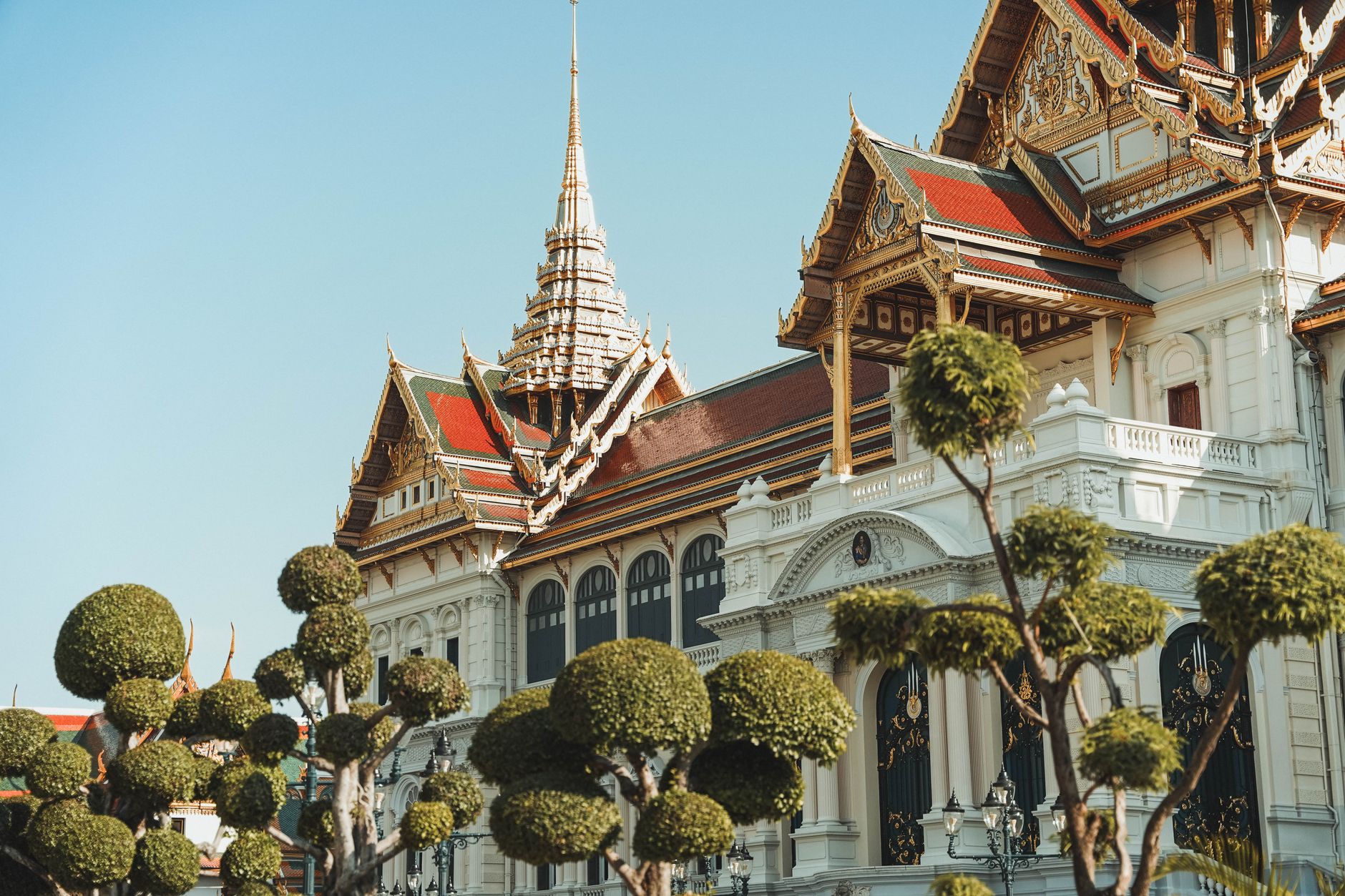
- Bangkok's Grand Palace. The Chakri Maha Prasat throne hall, completed in 1882, is European in its lines and proportions below a tiered Thai roof — modernisation made visible, by design.
- Bang Pa-In, outside Ayutthaya. Rama V's summer palace sets a Chinese-style hall, a European villa and a Thai pavilion in one garden. It reads as a statement about who was borrowing from whom.
- Ayutthaya's ruins and the Golden Triangle. Wat Mahathat and Wat Chaiwatthanaram show what 1767 cost; the river bend above Chiang Rai shows where three empires touched.
A day among the Ayutthaya ruins covers the older half of this story in detail, and the Kanchanaburi and River Kwai guide covers the hardest part of the later one.
For travellers who want the whole arc in one trip, the Grand Thailand Journey runs 15 days and 13 nights from Bangkok through Kanchanaburi, Ayutthaya, Sukhothai, Chiang Rai and Chiang Mai to Phuket, from $2,999 per person, land only. For a shorter version of the same history, the Thailand Heritage Escape is 5 days and 4 nights across Bangkok, Kanchanaburi and Ayutthaya, from $499 per person, land only, starting and ending in Bangkok.