Chiang Rai in a Day: 6 Things to Know About the White Temple, the Blue Temple and the Golden Triangle
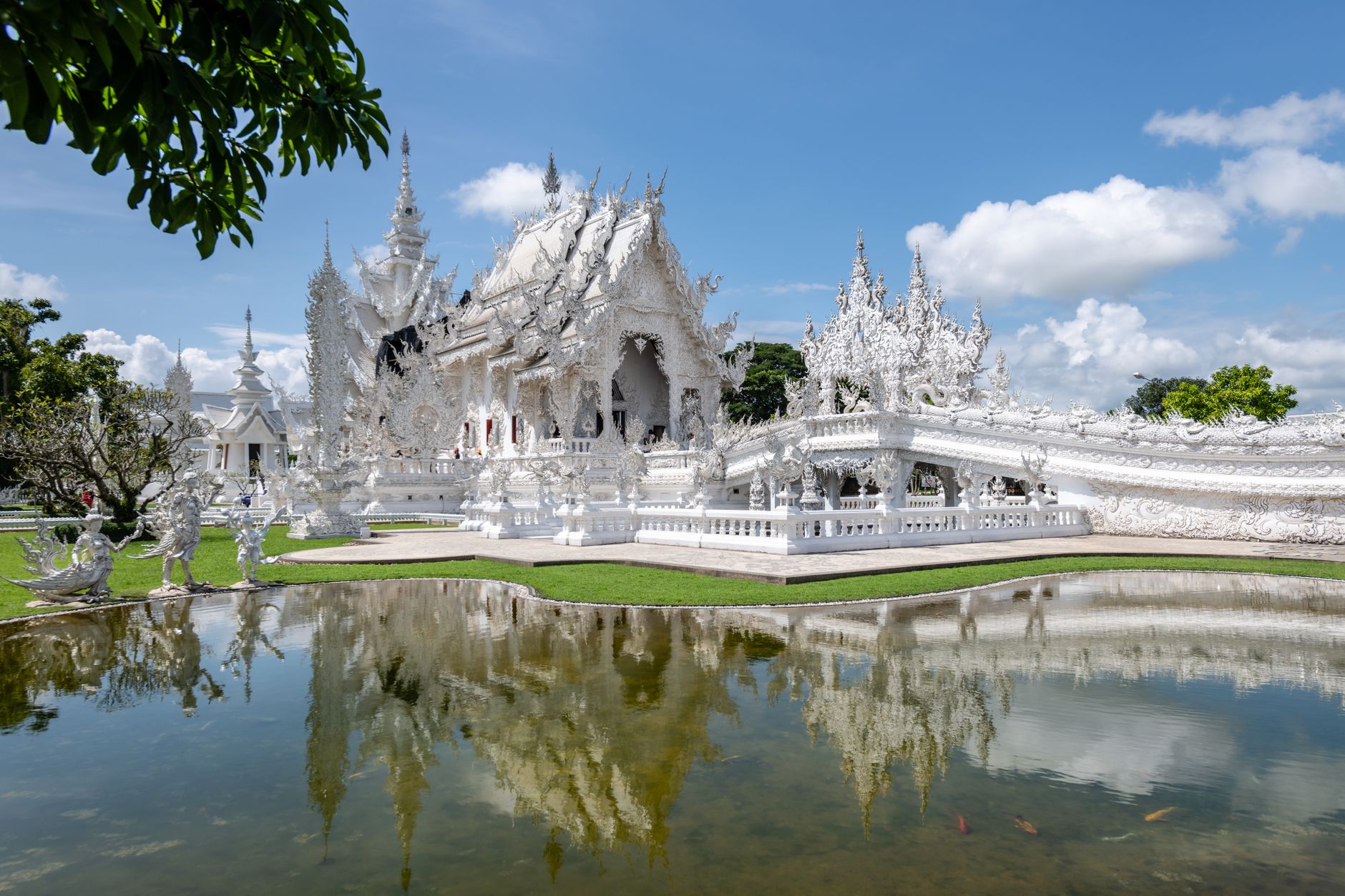
Chiang Rai gets squeezed. On a lot of Thailand trips it's a single long day from Chiang Mai — three hours up, a temple, a viewpoint, three hours back — and travelers come home remembering it as a photo stop rather than a place. That's a shame, because Thailand's northernmost province holds two of the country's most startling modern temples, the storied corner where three countries meet on the Mekong, and a quieter, older Lanna town than the one everyone flies into. Here are six things worth knowing before you go, whether you're day-tripping or staying the night.
1. The White Temple is an artwork first, a temple second
Wat Rong Khun — the White Temple — is the project of Chalermchai Kositpipat, a Chiang Rai-born artist who took over the site of a decaying local temple and reopened it in 1997 as something between a wat and a sculpture park. He has funded and directed the work himself ever since, and construction continues to this day; the master plan runs to several more buildings than currently stand.
Everything you've heard about it being white is true, but the photographs miss the texture. The plaster is embedded with fragments of mirrored glass, so the whole structure glitters and shifts as the light moves — white for the purity of the Buddha's mind, the mirrors for his wisdom reflecting through the world. You enter the main ubosot by crossing a narrow bridge over a pit of sculpted, grasping hands: the cycle of desire and rebirth, crossed in a single direction. Attendants keep the line moving one way for exactly that reason — there's no wandering back.
Two details travelers consistently miss: the murals inside the ubosot, which fold surprisingly modern imagery into traditional Buddhist cosmology (no photos allowed — look instead), and the ornate golden building on the grounds, which turns out to be the restrooms. That's deliberate. Gold stands for the body and worldly wants; white for the mind. The joke is part of the sermon.
2. Timing decides your whole experience there
The White Temple sits about 15 minutes south of Chiang Rai town, directly on the highway from Chiang Mai — which means the day-trip buses from Chiang Mai all arrive in the same late-morning window. Get there at opening and you'll share the bridge with dozens of people; arrive at midday and it's hundreds.
If you're staying in Chiang Rai, go first thing and you'll have the reflecting pond to yourself for the classic shot. If you're coming up from Chiang Mai, the opposite logic can work too: stop at the White Temple on the way north in the morning, or hold it for the late afternoon on the way back, when the big groups have cleared and the low sun lights the mirrored plaster. The grounds are compact — an unhurried visit runs about an hour.
3. The Blue Temple is the color answer, ten minutes away
Wat Rong Suea Ten — the Blue Temple — sits across town on the north bank of the Mae Kok River, and it completes the pair. It was finished in 2016 by Phuttha Kabkaew, an artist who worked under Chalermchai on the White Temple, and the lineage shows: the same swirling, sculpted ornament, but rendered in deep sapphire blue shot through with gold, and a luminous white Buddha presiding inside under a vaulted indigo ceiling.
The name means "house of the dancing tiger," after the tigers that once roamed this bend of the river. It's smaller than the White Temple, free to enter, and far less crowded — fifteen or twenty minutes is enough, and those minutes tend to be the most saturated color most travelers see all trip. Visiting both temples in one morning is easy and worth it; they read like two movements of the same piece.
4. The Golden Triangle is a geography lesson with a view
An hour or so north of Chiang Rai town, the Ruak River runs into the Mekong, and the land folds into three countries at once: Thailand on your bank, Myanmar across the Ruak, Laos across the Mekong. This is the Golden Triangle — the name once attached to the wider opium-growing borderlands, now anchored to this photogenic confluence at the village of Sop Ruak.
Climb to the hillside viewpoint and the three-countries panorama opens up, with longtail boats tracing wakes down the Mekong below. The history is told frankly here: museum exhibits in the area cover how the opium economy took root in these hills in the nineteenth century and how decades of crop-substitution programs — coffee, tea, macadamia — slowly replaced it. It's one of the few stops in Thailand where the view and the history lesson are the same thing. Pair it with the drive along the Mekong and the far north starts to feel like what it is: a borderland, with a texture Bangkok and the beaches don't have.
5. Chiang Rai town is older than Chiang Mai — and calmer
King Mangrai founded Chiang Rai in 1262, three decades before he founded Chiang Mai, and for those early years it was the seat of his growing Lanna kingdom. The capital moved; the crowds eventually followed. Today Chiang Rai is the far quieter of the two northern cities — a walkable grid near the Mae Kok River with a lively night bazaar, good khao soi, and none of the elbow-to-elbow feel of Chiang Mai's old city in high season.
If the north's Lanna identity interests you, the differences from the rest of Thailand run deeper than temple styles — the food, the language, the festivals all have their own lineage, which is a story of its own: see what makes northern Thai culture different from Bangkok. And if you want to decode what you're looking at on any wat, white, blue or gold, start with the visual grammar of Thai temple architecture.
6. Staying the night beats the there-and-back day trip
The round trip from Chiang Mai is roughly six hours of road for perhaps four hours on the ground. It's doable, and plenty of travelers do it — but sleeping in Chiang Rai turns the same sights into a different trip: the White Temple at opening before the buses, the Golden Triangle without a clock running, an evening at the night bazaar instead of a highway.
That's how small-group itineraries that take the north seriously tend to structure it. Asia Bound's Grand Thailand Journey (15 days / 13 nights, from $2,999 per person, land only) routes from Sukhothai up to Chiang Rai before continuing to Chiang Mai and on to Phuket, and the Thailand Discovery journey (12 days / 10 nights, from $2,199 per person, land only) finishes its northern arc with Chiang Rai after Chiang Mai — in both cases with time for the White Temple, the Blue Temple and the Golden Triangle at the hours they're at their best, with an independent local operator's guides handling the road.
However you get there, give the far north more than a photo stop. Two temples unlike anything else in the country, three nations in one view, and the oldest Lanna town of them all — Chiang Rai earns the extra night.