What Makes Northern Thai Culture Different From Bangkok?
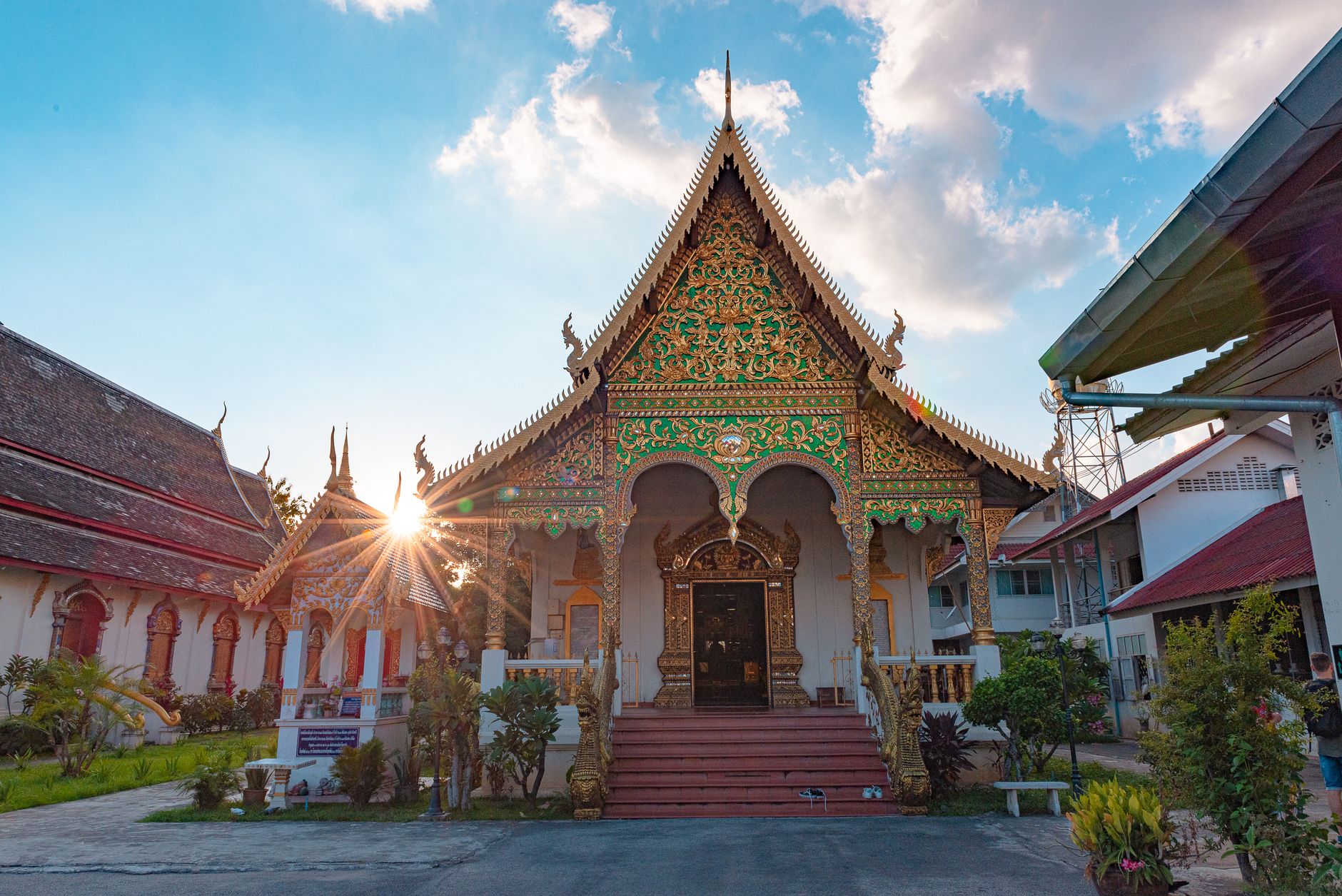
Travelers who fly from Bangkok to Chiang Mai sometimes expect a smaller, greener version of the same place. What they land in is closer to a different country that happens to share a passport. The north was its own kingdom — Lanna, "a million rice fields" — founded at Chiang Mai in 1296 and not folded into the Siamese administrative system until the very end of the 1800s. Six hundred years of separate rule leaves marks, and most of them are still legible: in the language on the signage, the plate at lunch, the shape of a temple roof, even the temperature at breakfast.
Here is what actually differs, and where a traveler notices it.
It was a kingdom, not a province
King Mangrai founded Chiang Mai in 1296 as the capital of Lanna, a state that ran across what is now northern Thailand and spilled into Laos and Myanmar. Lanna spent roughly two centuries as a power in its own right, then more than two hundred years under Burmese rule from the mid-1500s, before falling into the orbit of Bangkok as a tributary kingdom in the late 1700s. Chiang Mai kept its own ruling house, with a prince in residence, until administrative reforms absorbed the north into the central Thai state around 1899.
That timeline matters because Bangkok is, by Thai standards, new. The Rattanakosin capital was founded in 1782 — Chiang Mai was already almost five centuries old. Bangkok's great monuments were built by a confident centralizing dynasty with access to Chinese trade and, later, European engineering. Lanna's were built by a mountain kingdom trading north and west, toward Burma and Yunnan. The two cities are not early and late versions of one tradition. They are two traditions.
The language is a different language
Standard Thai is the language of school, television and government, and everyone in Chiang Mai speaks it. At home and in the market, many people speak Kam Mueang — northern Thai — which is distinct enough from the central language that central Thais do not reliably understand it. The tones differ, the vocabulary differs, and the courtesy particle most visitors learn as khrap or kha becomes jao in northern speech.
Lanna also had its own writing system, Tai Tham, sometimes called tua mueang. It is rounder and more curled than the Thai script, and it survives mostly on temple signage, monastic manuscripts and self-consciously northern shopfronts and beer labels. Spotting it on a temple gate is a reliable way to know you have crossed out of the central-plains world.
The food is less sweet, less coconut, more herb
This is the difference most travelers register first, usually within a day. Northern cooking leans on sticky rice rather than jasmine rice; it is eaten by hand, rolled into a ball, and used to pick up everything else. Coconut milk, which does so much work in the southern and central kitchen, is comparatively scarce. Sugar is used with restraint. Bitter greens, fresh herbs and dried spice do more of the lifting.
The dishes worth knowing by name:
- Khao soi — egg noodles in a mild curry broth with crisp fried noodles piled on top, served with pickled mustard greens, shallot and lime. The signature plate of Chiang Mai.
- Sai ua — grilled pork sausage shot through with lemongrass, galangal, kaffir lime leaf and chilli. Sold by the coil at every market.
- Nam phrik noom and nam phrik ong — a roasted green chilli dip and a tomato-pork dip, both eaten with sticky rice, crisp pork and raw vegetables.
- Kaeng hang le — a slow-braised pork belly curry with tamarind, ginger and turmeric, carrying clear Burmese influence and almost no coconut.
- Khantoke — not a dish but a format: a low lacquered tray holding several northern dishes at once, eaten seated on the floor.
Order som tam in Chiang Mai and you may get the northern style, with fermented fish and a quieter sweetness, rather than the bright, sugary Bangkok version. Neither is wrong. They are regional.
The temples follow different rules
A traveler who has spent three days in Bangkok arrives north with an eye trained on Rattanakosin temple design: tall, gilded, steep-roofed, densely ornamented, often faced in coloured glass and porcelain. Lanna building reads quieter. Roofs sweep lower and in more tiers, closer to the ground. Teak does structural work that the central plains did in brick and stucco. Chedis tend toward a bell or stepped-square form rather than the tall corn-cob prang borrowed from Khmer models.
Four buildings make the point on foot in a single morning. Wat Chiang Man is the oldest temple in the city, founded by Mangrai in the year the city was. Wat Phra Singh holds the finest surviving Lanna viharn in Chiang Mai, small and wooden and low. Wat Chedi Luang is the ruin of a fifteenth-century chedi that once stood far higher before an earthquake brought its upper section down in the 1540s. Doi Suthep, founded in 1383, sits above the city at the top of a naga staircase and is the north's principal pilgrimage site.
Chiang Rai, two hours further on, adds a third layer: contemporary temple art built in deliberate conversation with tradition. Wat Rong Khun — the White Temple — and the Blue Temple are both recent works by local artists, strange and theatrical, and entirely unlike anything in the Bangkok temple circuit.
Ritual life is more visible
Northern religious practice keeps older animist layers closer to the surface. Spirit belief, protective thread-tying and the bai sri su khwan blessing ceremony are widely practised. Chiang Mai holds Inthakhin, a week-long festival in May devoted to the city pillar at Wat Chedi Luang, during which residents bring flowers and water to secure the city's well-being for another year — a civic ritual with no Bangkok equivalent.
The festival calendar diverges too. Songkran in April runs longer and harder in Chiang Mai, organized around the old moat, and the north preserves the gentler original form alongside the water fight: rot nam dam hua, pouring scented water over the hands of elders. And in November the north observes Yi Peng, the Lanna lantern festival, at the same full moon as Loy Krathong — sky lanterns rather than only floating ones. That overlap is the single busiest week of the Chiang Mai year, and worth planning around deliberately; the practicalities are covered in Yi Peng and Loy Krathong in Chiang Mai.
Pace, manners and weather
Chiang Mai is a city of roughly 130,000 inside the municipality and well under a million across the metro area; Bangkok is a megacity of more than ten million. The difference shows in volume and tempo. Conversation is quieter, bargaining softer, and a reputation for understatement is something northerners claim for themselves.
The climate differs more than most visitors expect. The north sits at altitude and well inland, so cool-season nights from December to February can drop into the low 50s Fahrenheit, and higher ground gets genuinely cold — a jacket is not optional in January. The trade-off comes in late February through April, when agricultural burning across the upper north settles haze over the valley; travelers sensitive to air quality should weigh those months carefully. Bangkok, humid and flat and coastal, never does either thing.
Seeing both on one trip
The honest answer to "which one" is usually both, in that order, with the south-to-north sequence doing the explaining. Bangkok first establishes the central-plains baseline — Grand Palace, Wat Pho, Wat Arun — and the north then reads as a departure from something you have actually seen rather than an abstraction.
That is how Asia Bound's itineraries are built, and the journeys are run on the ground by BCX, an independent local operator headquartered in Bangkok. The Thailand Discovery journey runs 12 days and 10 nights from Bangkok through Ayutthaya and Sukhothai to Chiang Mai and Chiang Rai, from $2,199 per person, land only — the full Siam-to-Lanna arc with the old capitals in between. The Thailand Culinary Journey takes the shorter route, 11 days and 9 nights through Bangkok, Ayutthaya and Chiang Mai, from $2,399 per person, land only, with the regional cooking difference as the through-line rather than a side note.
If you are still weighing the regions against each other, Bangkok vs. Chiang Mai vs. Phuket compares them directly on atmosphere, food, cost and weather. Questions about departures or what a given day looks like are best answered directly — the contact form reaches the people who plan them.