Two Markets, One Morning: Damnoen Saduak and the Maeklong Railway Market
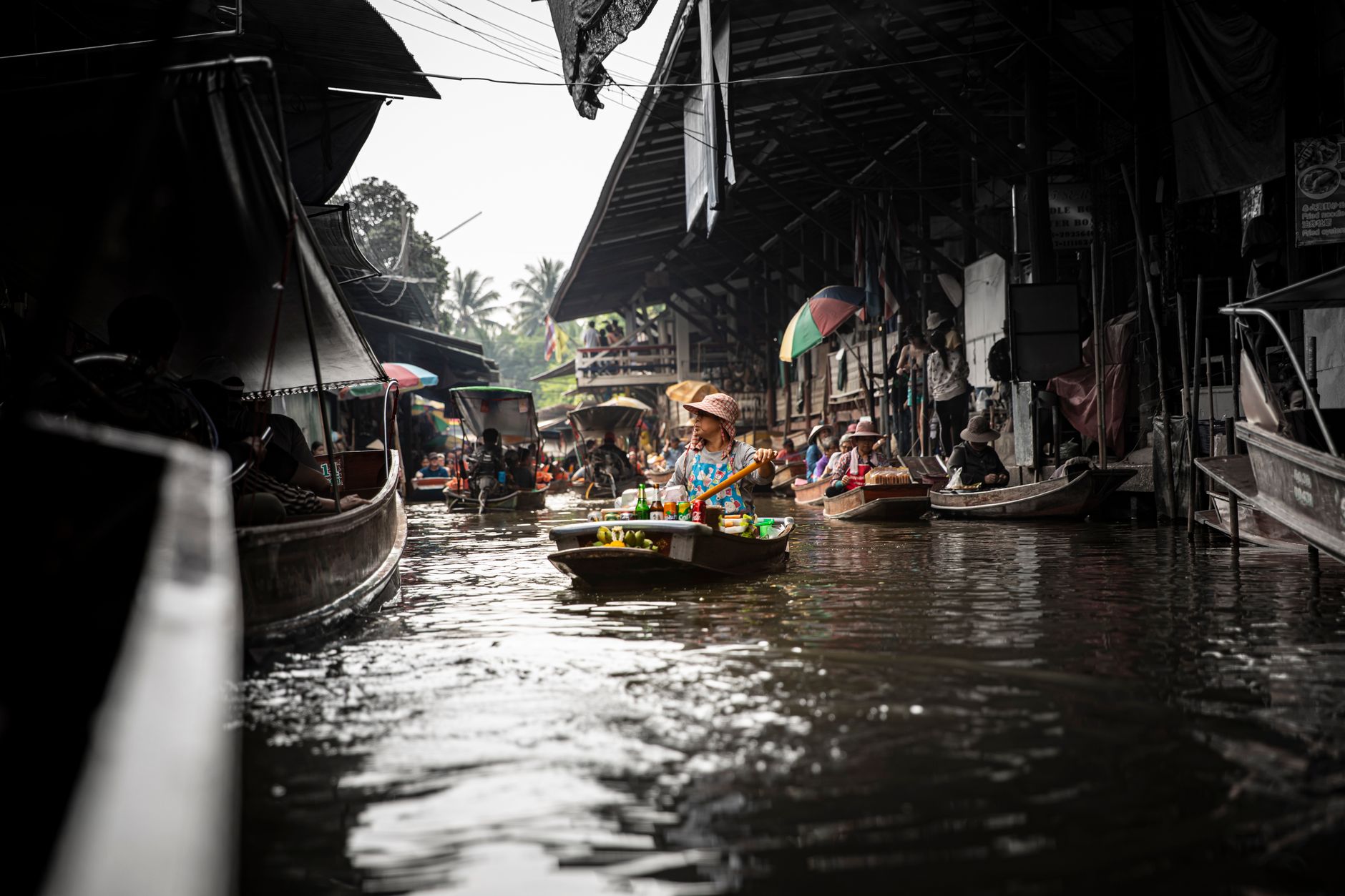
The vans leave Bangkok in the dark. By 6:00 a.m. the expressway heading southwest is already busy with tour traffic, because two of Thailand's most photographed markets sit out this way — about ninety minutes from the city — and both do their best work before ten o'clock. Damnoen Saduak, the floating market, peaks in the first two hours after sunrise. The Maeklong Railway Market has a schedule written by the state railway: a few times a day a train rolls through the middle of it, and the whole market folds out of the way.
Done in the right order, the two make a single unhurried morning. Here is how that morning actually unfolds.
6:00 a.m. — The road southwest
The drive out of Bangkok runs through Samut Sakhon's salt flats, where in the dry months low white pyramids of sea salt line the highway and workers rake the evaporation ponds in wide-brimmed hats. It is an easy ride to sleep through, and most people do, but the salt fields are the first sign that this is a different Thailand from the capital — a flat, wet, canal-cut delta province where life has always moved by water.
Damnoen Saduak lies in Ratchaburi province, roughly 100 kilometers from central Bangkok. The canal that gives the market its name was dug by royal order in the 1860s, under King Rama IV, to connect the Mae Klong and Tha Chin rivers — a straight, 30-odd-kilometer cut that turned the surrounding orchards and coconut groves into some of the best-connected farmland in Siam. Farmers sold from boats because boats were how everything moved. The market came first; the tourists came a century later.
7:15 a.m. — Boats at Damnoen Saduak
Arriving early matters here more than almost anywhere else in Thailand. Between about 7:00 and 9:00 a.m., the khlong is a working spectacle: flat wooden paddle boats loaded with mangoes, rose apples, bananas and pomelos; vendors in indigo farmer's shirts and woven hats sculling with a single stern oar; cooking boats with charcoal braziers balanced amidships, turning out boat noodles, grilled river prawns and coconut pancakes crisped in blackened iron pans. By 10:30 the light goes flat, the souvenir trade takes over, and the magic thins out considerably.
The standard visit is a ride in a paddled or motor-driven boat along the market canal and the narrower side khlongs behind it, where stilt houses back onto the water and the crowds disappear within two bends. The side canals are the part worth insisting on: the main stretch gets congested with boat traffic by mid-morning, but the back lanes still feel like the delta going about its business — a postman's motorbike crossing a plank bridge, spirit houses facing the water, coconut plantations in neat flooded rows.
Two practical notes. First, prices at the market itself are tourist prices; bargain politely and expect to settle around half to two-thirds of the opening number for souvenirs. Second, eat from the cooking boats — the food is the point. A bowl of noodles eaten from a boat deck, passed hand to hand over the water, beats any restaurant version of the same dish. Mango sticky rice and khanom khrok (little coconut-rice griddle cakes) are the reliable closers.
9:45 a.m. — The drive to Maeklong
From Damnoen Saduak it is a 30–40 minute drive south to the town of Maeklong in Samut Songkhram, Thailand's smallest province, down where the Mae Klong river meets the Gulf. The timing is the whole trick of this itinerary: the goal is to be standing in the railway market comfortably before the late-morning train arrives, with time to walk the tracks while the market is in its normal state.
Thais call this market Talat Rom Hup — "the umbrella pull-down market" — which describes it better than any guidebook. A working fresh market, several hundred meters of it, is laid out directly on and over the tracks of a functioning railway line. Fish, crabs and shellfish from the nearby gulf sit in trays at rail level; awnings and umbrellas roof the line over completely, so walking it feels like moving through a dim, fragrant tunnel of produce.
10:45 a.m. — The train comes through
The line into Maeklong is one of Thailand's shortest and most eccentric: a stub of track running up the coast toward Ban Laem, with a handful of round trips a day. When a train is due, a bell sounds and an announcement crackles down the line — and the market performs its famous trick. Awnings swing back on hinged arms, umbrellas collapse, trays of seafood slide a few hand-widths inward, and within a couple of minutes a corridor exactly one train wide has opened through the middle of the market.
Then the train eases through at walking pace, close enough that its skirts pass directly over the produce that stayed put. Vendors barely look up. The moment it clears, the umbrellas bloom again, the trays slide back, and within sixty seconds the tunnel has reassembled itself as if nothing happened. The whole event takes perhaps five minutes, and it is worth every bit of its fame — not as a stunt, but as a demonstration of how completely ordinary the extraordinary can be when it happens eight times a day.
Train times shift with the seasonal timetable, so guides confirm the day's schedule locally; the mid-morning arrival, typically between 8:30 and 11:30, is the one most day trips are built around. Stand behind the painted line where vendors indicate, keep bags and elbows inside it, and let the people whose livelihood this is manage the choreography.
Fitting it into a Thailand trip
Both markets sit west of Bangkok, in the opposite direction from Ayutthaya and the north, which is why they work best as a dedicated morning out of the capital rather than a stop en route to somewhere else. Most travelers are back in the city by early afternoon with the whole evening still ahead — a schedule that pairs naturally with a Bangkok hotel stay at the start or end of a longer journey.
On Asia Bound's small-group itineraries, Bangkok anchors every trip, so a market morning like this slots in neatly as pre- or post-tour time. The Thailand Heritage Escape — five days through Bangkok, Kanchanaburi and Ayutthaya, from $499 per person, land only — starts and ends in Bangkok, leaving an open morning on either side for exactly this kind of excursion. Travelers on the longer Grand Thailand Journey often add a day in Bangkok before the tour begins and use it the same way.
Early risers who catch the market bug can double down in the capital itself: Bangkok's flower market runs its own pre-dawn drama of deliveries and garland-stringing, covered in What Happens Before Sunrise at Bangkok's Flower Market? And for the after-dark counterpart to this morning, Inside Thailand's Night Markets walks through how the country's evening markets build from setup to close.
The vans roll back into Bangkok around 1:00 p.m., their passengers smelling faintly of charcoal smoke and holding bags of fruit they did not plan to buy. As market mornings go, it is hard to spend a better one.