Inside Thailand's Night Markets: More Than Just Shopping
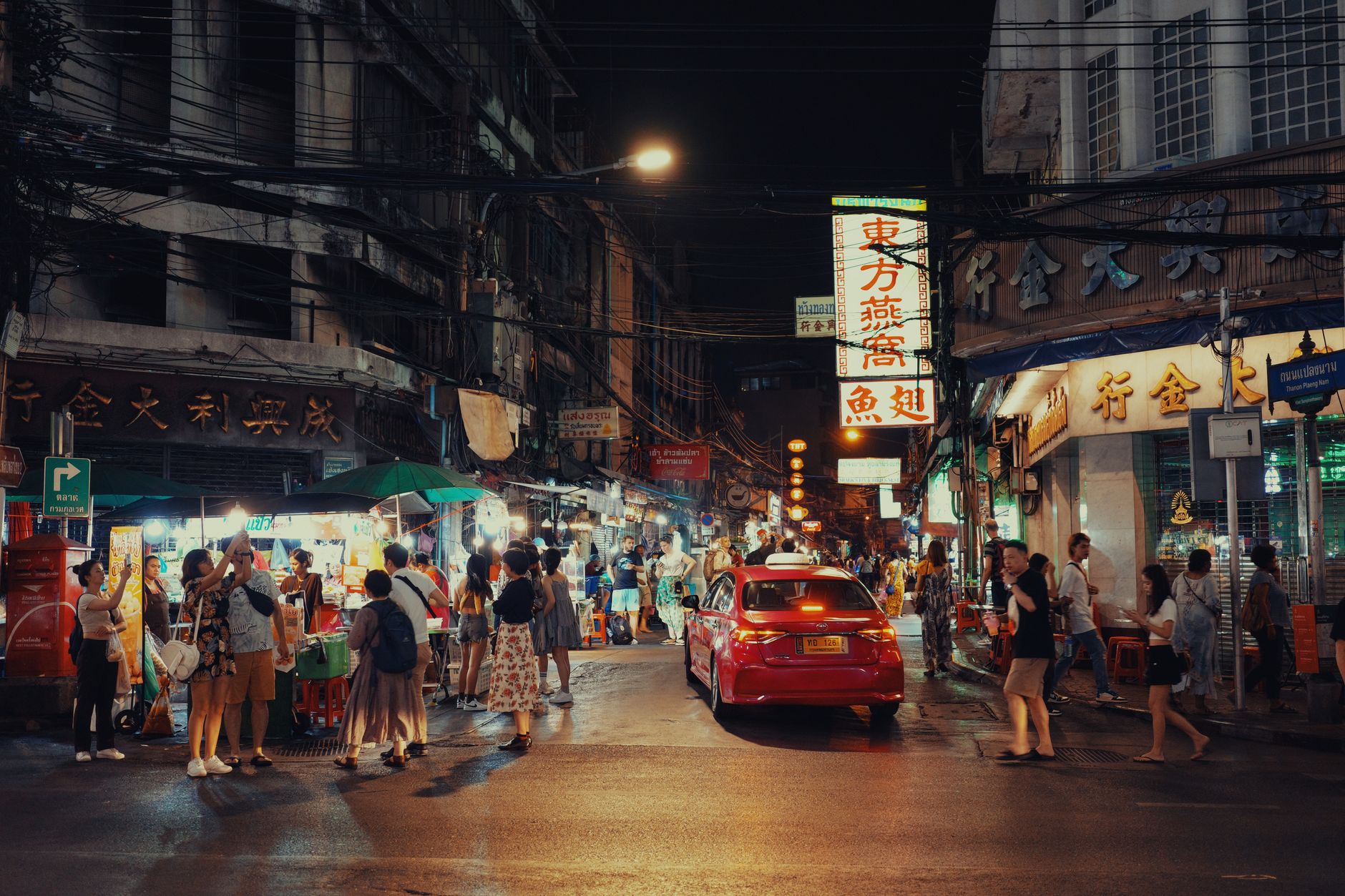
Around five in the afternoon, in towns across Thailand, a particular transformation begins. A street that spent the day as ordinary traffic — or an empty lot that spent it as parking — sprouts steel frames, tarpaulins, folding tables and strings of bulbs. Vans and motorbike sidecars unload in a choreography that looks chaotic and isn't; most vendors have set up in the same three square meters for years. By the time the heat finally breaks, around sunset, the grills are lit, the lights come on, and the market that didn't exist two hours ago is the busiest place in town.
That daily rebuild is the first thing to understand about Thai night markets: they are not primarily tourist attractions. They exist because of the climate and the rhythm of Thai life. Midday is too hot for strolling, so commerce and social life shifted to the evening generations ago. Thais come after work to eat dinner, meet friends, buy phone cases and school clothes, and walk slowly in the one part of the day when walking slowly is pleasant. Travelers are welcome — warmly — but at most markets they're a minority, which is exactly what makes the experience worth having.
The food side comes alive first
Follow the smoke and you'll find the market's real center of gravity. The first hour after dark belongs to food: moo ping (grilled pork skewers, usually 10–20 baht each) over charcoal, som tam pounded to order in a clay mortar — you can ask for pet nit noi, "just a little spicy," and should — whole fish packed in salt crusts, banana-leaf parcels, pad thai flipped in woks the size of satellite dishes, and sweet finishes like khanom krok (coconut-rice pancakes) and mango sticky rice.
A few practical notes serve you well here. Busy stalls with high turnover are the safe stalls; a line of locals is a better hygiene certificate than any sticker. Carry small notes — a 20 and a handful of coins go further than a 1,000-baht bill a vendor may not be able to change. Most dishes run 40–80 baht, so two people can graze across six or eight stalls for less than the cost of one hotel dinner. And the plastic-stool seating clustered behind the stalls is shared freely: buy from one vendor, sit anywhere near, and nobody minds.
This graze-as-you-go dinner is, for many travelers, the single best meal format in Thailand — which is why the Thailand Culinary Journey (11 days through Bangkok, Ayutthaya and Chiang Mai, from $2,399 per person, land only) builds evening market time into its itinerary rather than treating it as free-time filler.
Then the browsing begins
An hour or so in, the crowd's attention drifts from food to goods. The retail half of a Thai night market has its own logic. Some of it is everyday commerce aimed at locals: socks, kitchen tools, toys, phone accessories. Some of it is made for visitors: carved soaps, triangle cushions, elephant-print trousers, mango-wood bowls. And at the better markets a third layer has emerged over the past decade — young Thai designers selling handmade leather, indigo-dyed cotton, ceramics and silver that you genuinely won't find at the next stall over.
Bargaining is expected on unpriced goods, but it's a friendly sport, not combat. Smile, counter at a bit more than half, settle somewhere in the middle, and let 20 baht go rather than souring the exchange — the difference matters more to the vendor than to you. Anything with a printed price tag, and all food, is fixed-price.
What surprises many first-time visitors is how much of the evening isn't transactional at all. Night markets double as public space: live music from a busker or a small stage, students sharing one plate of som tam for an hour, three generations of a family out together, monks browsing the amulet tables. Thailand's towns don't organize themselves around plazas the way European cities do; the night market is the plaza. Go without a shopping list and you'll see more.
Where the evening plays out
Every Thai town has at least one night market, but a few on the main travel routes show the form at its best.
In Chiang Mai, the Night Bazaar along Chang Khlan Road runs every single night of the year — several blocks of stalls, food courts and covered arcades that have anchored the city's evenings for decades. It sits an easy walk from the Ping River and the old city's eastern gate, which is part of why Chiang Mai evenings on a small-group itinerary so often end here.
In Bangkok, the purest night-eating district is Chinatown, where Yaowarat Road's food stalls ignite at dusk — an experience covered in detail in Where to Shop in Bangkok, alongside the city's weekend-market and mall options. Bangkok's markets skew bigger and more specialized than anywhere else in the country, from wholesale flowers to vintage denim.
In Phuket Old Town, Thalang Road closes to traffic on Sunday evenings for a walking-street market set against the district's Sino-Portuguese shophouses — one of the few places where the architecture competes with the stalls for your attention. And in Krabi, the weekend night market near Ao Nang gives beach-bound travelers their dose of grilled seafood and live music a short ride from the sand.
Closing time, and how to time your visit
By ten or eleven — midnight at the big city markets — the reverse choreography begins. Grills are scraped, tarps folded, frames stacked into the same vans, and by morning the street belongs to traffic again, with almost no trace of the ten thousand meals served the night before.
For travelers, the timing lesson is simple. Arrive hungry around 6:30 or 7, when everything is cooking and the full stall lineup is open, and eat first — the food stalls peak early and some sell out. Browse afterward, when you can judge a carved bowl on its merits rather than through low blood sugar. Weeknights are calmer than weekends at most markets; the big weekend-only events are livelier but denser. And if crowds wear on you, the first open hour is always the quietest — a principle that applies to much of Thailand, as covered in Seven Ways to See Thailand Without the Crowds.
Most small-group itineraries leave evenings unscheduled precisely so this can happen. On Asia Bound's longer routes — the 12-day Thailand Discovery through Bangkok, Ayutthaya, Sukhothai, Chiang Mai and Chiang Rai, from $2,199 per person, land only — that means several market towns in a row, each with its own evening to wander. A guide from the independent local operator can point you toward the night's best market and the stalls worth a line; the wandering itself needs no itinerary at all.
Dinner, shopping, people-watching and public life, rebuilt from scratch every single evening: that's the night market. Bring small bills and an appetite, and plan nothing afterward.